Skip to content
Instructions:
- Begin by ensuring the turkey is fully thawed; if frozen, allow 24 hours per 4–5 pounds in the refrigerator at or below 40°F (4°C).
- Remove the turkey from the refrigerator 20–30 minutes before cooking, but do not leave it out for extended periods to avoid bacterial growth.
- Preheat your oven to 325°F (163°C) and position a rack in the lower third to provide enough space for the turkey and roasting pan without touching the heating element.
- Prepare a large roasting pan with a rack; if no rack is available, create a stable bed with thick onion slices or sturdy vegetables to lift the turkey.
- Unwrap the turkey, remove the neck and giblet packets from both cavities, and set aside or discard as preferred. Avoid rinsing the bird to prevent cross-contamination.
- Pat the turkey thoroughly dry with paper towels both inside and out; dry skin is crucial to help the compound butter adhere and to promote even browning during roasting.
- Place the turkey breast-side up on the rack and set aside while preparing the compound butter.
- In a medium bowl, combine softened unsalted butter with finely minced garlic, finely chopped fresh rosemary, thyme, sage, parsley, and lemon zest. Season with kosher salt, freshly ground black pepper, smoked paprika, and onion powder. Mix until evenly blended but do not melt the butter.
- Reserve about ¼ cup of this butter mixture for rubbing on the turkey’s exterior later; keep the rest ready for spreading under the skin.
- Gently loosen the skin starting at the neck end, sliding your fingers carefully between the skin and breast meat to create a pocket without tearing the skin. Extend this pocket toward the thighs if possible.
- Spread the majority of the compound butter evenly beneath the skin over both breasts and, if reachable, the upper thighs, using your fingers to smooth it out for uniform coverage.
- Return the skin to its natural position and massage gently to distribute the butter evenly beneath the surface.
- Use the reserved butter to coat the outside of the turkey breast, thighs, drumsticks, and wings, adding a tablespoon of olive oil if needed to help spread it smoothly and evenly.
- Place quartered onion, lemon, halved garlic head, and fresh herb sprigs loosely inside the turkey cavity, allowing space for heat circulation without packing tightly.
- Tuck the wing tips behind the bird’s back to prevent burning and optionally loosely tie the drumsticks together to maintain shape without restricting heat flow.
- Pour 2 cups of low-sodium chicken or turkey broth into the bottom of the roasting pan, avoiding pouring directly onto the turkey, to keep pan drippings moist and aid in gravy flavor.
- Insert an oven-safe meat thermometer into the thickest part of the breast, avoiding bone contact, and place the roasting pan in the preheated oven.
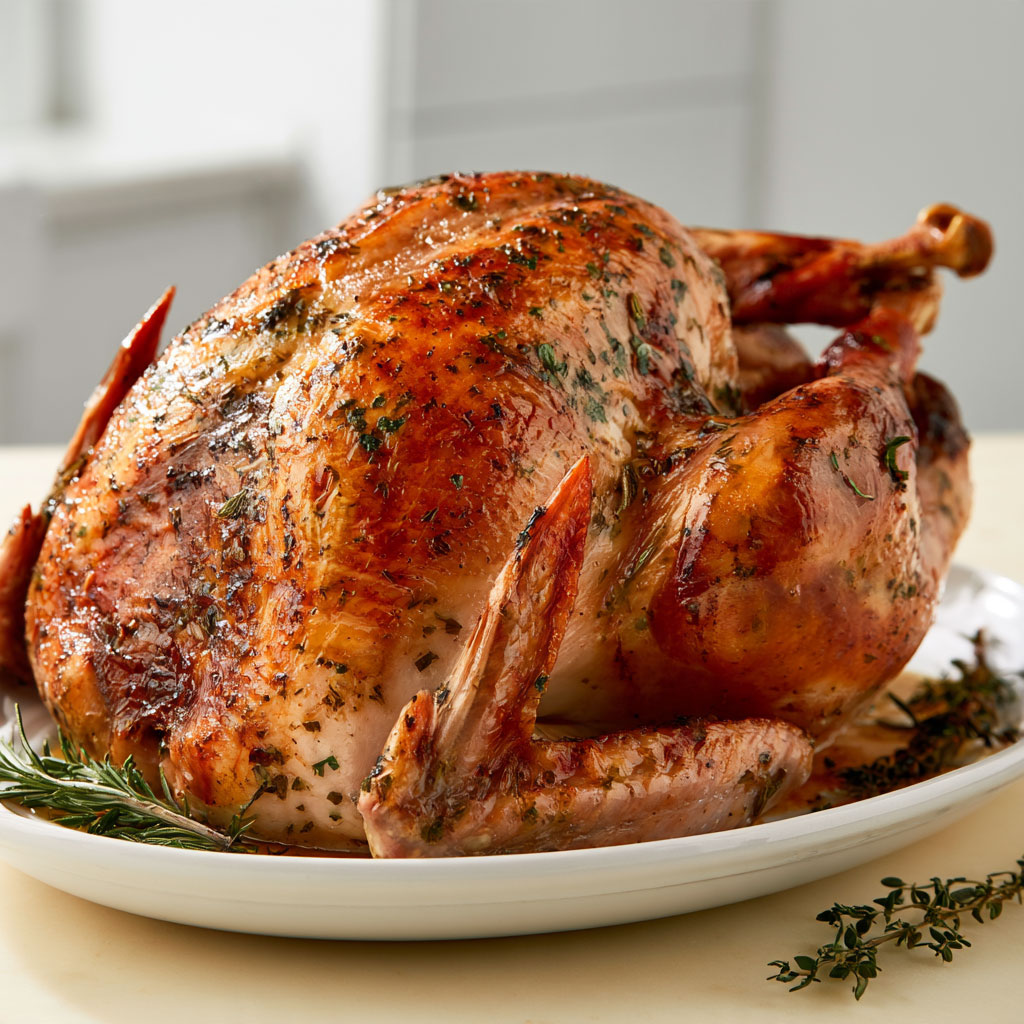
- Roast uncovered to allow the skin to brown evenly, planning for approximately 3 to 3¾ hours for a 12–14 pound bird but relying on internal temperature rather than time alone.
- Check the turkey after the first hour; if the pan looks dry, add a small amount of broth around the rack but not on the skin to avoid slowing browning.
- After two hours, monitor the skin color; if the breast browns too quickly, loosely tent with foil to prevent burning while allowing heat to circulate.
- Regularly check the internal temperature in the breast, thigh, and wing, aiming for at least 165°F (74°C) in all these areas for safe consumption.
- Once the turkey reaches the target temperatures, remove it from the oven carefully and transfer to a large cutting board or platter using sturdy utensils to avoid joint separation.
- Loosely tent with foil and let rest for 30–45 minutes; resting allows juices to redistribute and prevents excessive moisture loss during carving.
- While the bird rests, skim fat from the collected pan drippings and prepare the optional pan gravy by making a roux with butter and flour, then whisking in broth and reserved drippings until thickened and seasoned to taste.
- Remove cavity aromatics and tie, then carve the turkey by separating legs at the joints, slicing thighs, and carefully removing and slicing breast meat across the grain.
- Arrange the carved turkey attractively on a serving platter, garnishing optionally with fresh herb sprigs and serving gravy separately to preserve the crispy skin.
Variations
- Substitute fresh herbs with dried herbs, using smaller amounts since dried herbs are more potent—reduce quantities by about one-third.
- Add a teaspoon of crushed red pepper flakes to the compound butter for a subtle spicy kick.
- Replace lemon zest with orange or lime zest for a different citrus aroma and brightness.
- Incorporate a tablespoon of Dijon mustard into the compound butter for a tangy depth of flavor.
- Use flavored butter, such as garlic and herb butter blends, to simplify preparation while maintaining robust seasoning.
- For a smoky variation, increase the smoked paprika or add a few drops of liquid smoke to the compound butter.
Tips
- Store leftover turkey in shallow airtight containers within 2 hours of cooking to ensure food safety, refrigerating for up to 3–4 days.
- Reheat turkey slices gently in a covered baking dish with a splash of broth at 325°F (163°C) to prevent drying out, heating to an internal temperature of 165°F (74°C).
- Freeze cooked turkey in airtight containers for 2–3 months for best quality; thaw in the refrigerator before reheating.
- Prepare the garlic herb compound butter up to 3 days in advance and keep refrigerated in an airtight container; allow it to soften slightly before use.
- Use a reliable instant-read meat thermometer and check temperature in several spots to avoid overcooking, which causes dryness.
- Let the turkey rest loosely tented with foil after roasting to maintain crisp skin while allowing juices to redistribute.
- Rotate the roasting pan halfway through cooking if your oven has hot spots to promote even cooking and browning.