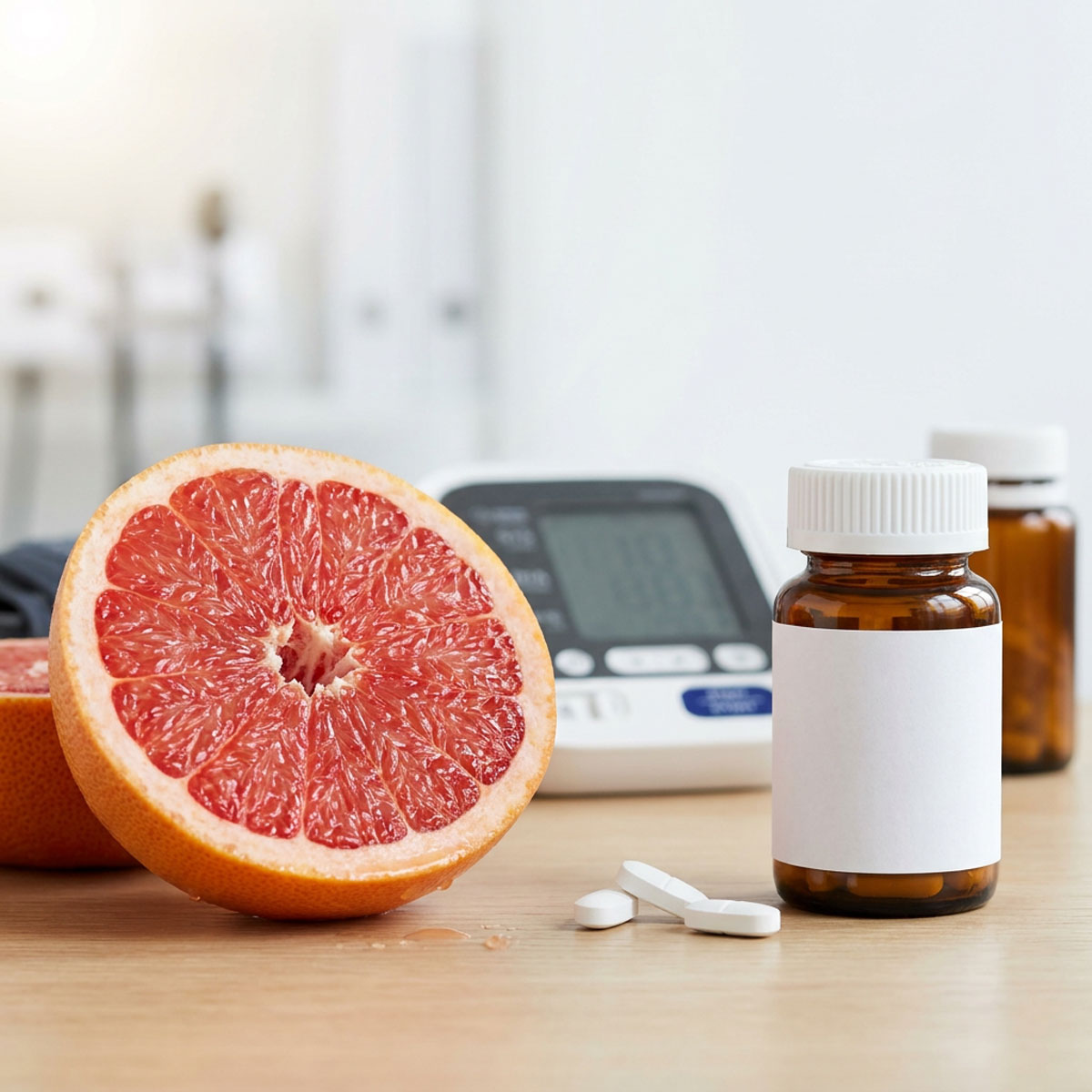
Grapefruit has long been praised as one of the healthiest fruits you can eat.
It’s packed with vitamin C, refreshing, and often included in heart-healthy diets. That’s exactly why most people never imagine it could affect a prescription medicine.
Yet grapefruit is one of the very few foods that can meaningfully change how certain medications behave inside the body.
The good news is that this topic is often misunderstood online. Grapefruit is not a dangerous fruit, and it does not interfere with most medications. The real issue is much more specific: certain medicines and grapefruit can interact in ways that matter, while many others are barely affected at all.
This article provides general information, not medical advice. If you discover that one of your medications may interact with grapefruit, the answer is to ask about the fruit—not to stop, skip, or change the medication on your own. Decisions about prescription medicines should always be made with your healthcare team.
Why grapefruit is different from almost every other food
Most foods have little effect on prescription medications.
Your morning toast usually doesn’t matter.
Your yogurt usually doesn’t matter.
Even most fruits have little influence on how medicines work.
Grapefruit is unusual because it contains natural compounds that can temporarily affect one of the body’s normal systems for handling certain drugs.
It isn’t because grapefruit is unhealthy.
It’s because your digestive system depends on enzymes to process many medications, and grapefruit can interfere with one of them.
The simple explanation: your body has a natural filter
Before many medicines reach your bloodstream, they pass through the wall of the small intestine.
There, an enzyme called CYP3A4 acts like a natural filter.
Imagine it as a security checkpoint.
As medicine passes through, this enzyme breaks down part of the dose before it continues into your bloodstream.
Drug manufacturers know this happens.
The prescribed dose is designed with that natural filtering process in mind.
Now imagine that the security checkpoint suddenly becomes much less active.
That’s essentially what grapefruit can do.
Natural compounds in grapefruit temporarily block much of the CYP3A4 enzyme in the small intestine.
As a result, less of certain medicines is broken down before entering the bloodstream.
The tablet didn’t become stronger.
The prescription label didn’t change.
The amount that actually reached your bloodstream did.
That is why grapefruit can make certain medications act more strongly than intended.