You wake at 2 a.m. with your tongue stuck to the roof of your mouth. There’s a glass of water on the nightstand, because there’s always a glass of water on the nightstand now. You drink, you roll over, you don’t think about it again.
Occasionally that’s nothing. A fan running, a dry bedroom in winter, a night of sleeping with your mouth open — everyone gets a parched morning now and then.
But if it’s most nights, two things are worth knowing, and neither of them is the thing people worry about.
The first is what saliva actually does. It isn’t just moisture. It buffers the acid that bacteria produce after every meal. It carries dissolved calcium and phosphate that continuously repair microscopic damage to your enamel. It contains antimicrobial proteins that hold the bacterial population down. Your mouth is under low-grade chemical attack all day, and saliva is the entire defense.
Here’s the part almost nobody is told: saliva production naturally falls to its lowest point while you sleep. Every night, everyone’s protection thins out for seven or eight hours. That’s normal. But if you’re already running dry on top of that nightly low, the defense isn’t thinned — it’s off. For a third of your life. Every night.
The Damage Nobody Sees Coming
Chronic dry mouth doesn’t hurt. It doesn’t announce itself. It shows up at a dental appointment eighteen months later as three or four cavities at once in someone who hasn’t had a cavity in a decade.
This hits harder after 60, and there’s a specific reason. As gums recede with age, they expose the root surface of the tooth — which isn’t enamel. It’s cementum and dentin, considerably softer, and it decays faster and at a milder acidity than enamel ever does. Add reduced saliva to exposed roots and decay can move quickly.
ADVERTISEMENT
The arithmetic is unforgiving. A filling runs $150 to $400. A crown, $1,000 to $2,500. Root canal with a crown on top, $2,000 to $4,000. A single implant to replace a tooth that couldn’t be saved, $3,000 to $6,000. Dry mouth doesn’t usually produce one cavity. It produces several, in the same year, in someone who thought their teeth were fine.
And then there’s the part that catches most people over 65 completely off guard: Original Medicare does not cover routine dental care. Not cleanings, not fillings, not crowns, not extractions, not dentures, not implants. That surprises almost everyone who hasn’t needed it yet. Some Medicare Advantage plans include dental coverage, and the annual enrollment window to switch runs October 15 to December 7 — which is worth knowing before you need the work, not after.
The Cause That Gets Missed Most
Of the eight explanations on the next page, one is both the most common and the most consistently overlooked: obstructive sleep apnea.
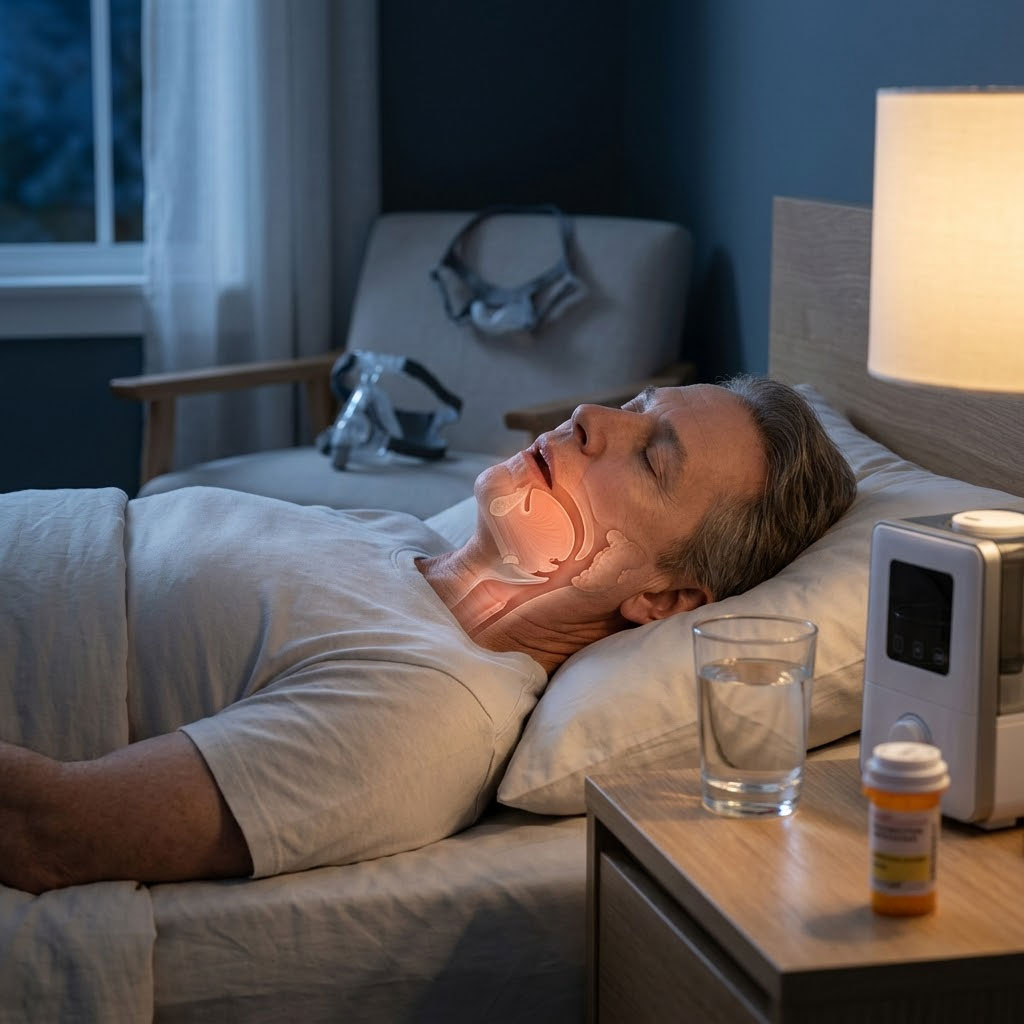
The mechanism is simple. When the airway collapses repeatedly through the night, the body compensates by breathing through the mouth. Hours of air moving across oral tissue evaporates saliva faster than it can be replaced. You wake up dry — and blame the bedroom air.
Which is why dry mouth on waking is one of the most useful clues there is. Most sleep apnea symptoms happen while you’re unconscious. You can’t notice your own snoring, your own gasping, your own breathing pauses. Unless someone sleeps beside you and tells you, those signs are invisible. Dry mouth is one of the few that’s still there when you open your eyes.
That matters because untreated sleep apnea isn’t a sleep problem. It’s a cardiovascular one — sustained links to high blood pressure, atrial fibrillation, stroke, heart disease, and type 2 diabetes. And it’s among the most treatable conditions in medicine once identified. Home sleep apnea tests have made diagnosis far simpler than the overnight lab study people are imagining, they’re often covered by insurance, and Medicare covers CPAP therapy once a diagnosis is on record. Oral appliances and other options exist for people who can’t tolerate a mask.
None of this means a dry mouth is an emergency. Most causes on the next page are ordinary, and several are fixable this week for free.
But two of the eight are conditions that quietly damage your body for years before anyone catches them — and one of them is a medication you’re probably taking right now, which almost nobody connects to their mouth at all.