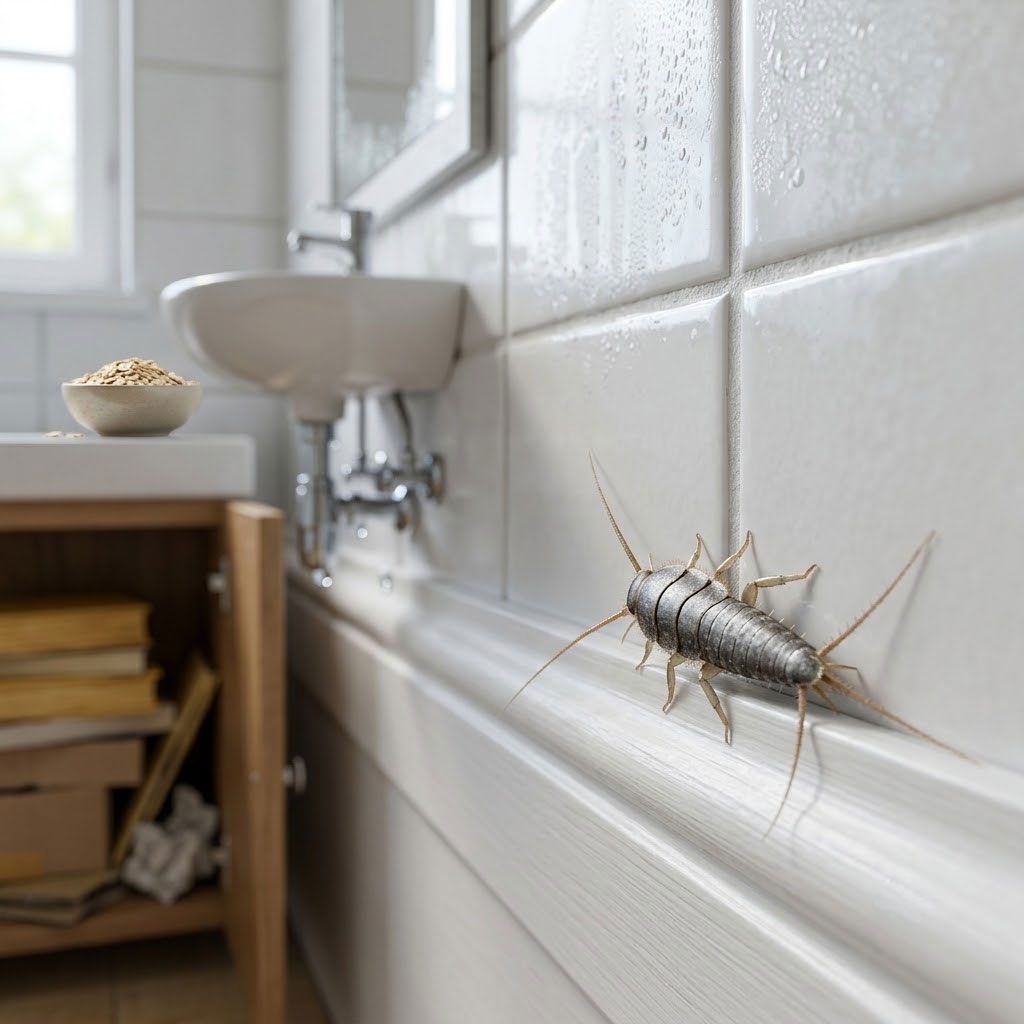
You flip on the bathroom light and something silver and fast darts across the floor and vanishes under the baseboard. A little unsettling, faintly prehistoric, and now you’re wondering what it was and whether there are more.
Here’s the reassuring part, and it’s genuinely true: the silverfish itself is almost nothing to worry about. It doesn’t bite. It doesn’t sting. It carries no disease. It won’t eat your house’s framing the way a termite does. As household pests go, it’s near the bottom of the threat list.
But that’s also exactly why writing it off is a mistake. A silverfish is not a problem. It’s a symptom — a small, visible, moving indicator of the one thing it cannot live without. And that thing, left alone, causes damage that costs thousands to undo.
What a Silverfish Actually Proves
Silverfish need humidity. Not prefer — need. They thrive in relative humidity above roughly 75 percent and struggle to survive, let alone breed, in dry air. This is why you find them in bathrooms, basements, laundry rooms, and under kitchen sinks, and almost never in a dry, well-ventilated bedroom.
So a silverfish is a live readout of a condition. Seeing one tells you a part of your home is holding more moisture than it should — and moisture, not the insect, is the expensive problem.
Because the same damp that a silverfish loves is the exact condition mold needs to grow.
That’s the connection worth sitting with. A silverfish and a mold colony want the identical environment. The insect just announces it first, because you can see it move. Mold works silently behind drywall, under flooring, inside a vanity cabinet, for months before it becomes visible or starts to smell. By the time you see a black patch or catch that musty note in the air, it has usually been established for a while.
Why This Is Worth Real Attention
This is where a bug article turns into a home-maintenance warning, and the numbers are the reason.
Left unaddressed, a hidden moisture problem doesn’t stay small. It moves in a predictable and increasingly expensive direction:
- Mold remediation. A small isolated patch might be a few hundred dollars. Mold that has spread inside walls, under flooring, or through an HVAC system routinely runs into the thousands, and a serious basement or whole-area remediation can reach five figures.
- Structural moisture damage. Persistent damp rots wood, degrades drywall, lifts flooring, and ruins insulation. What started as condensation becomes a repair bill.
- Basement waterproofing. If the moisture is coming from outside — a common source — professional waterproofing or drainage correction is frequently a multi-thousand-dollar job, and the longer it’s ignored, the more it takes with it.
- Air quality and health. Mold spores aggravate allergies and asthma, and matter most for the very young, the elderly, and anyone with a respiratory condition.
The silverfish costs you nothing. The condition it’s pointing at is one of the most expensive things that can quietly go wrong in a house. That asymmetry is the whole reason not to just squash it and move on.
Read the Location Like a Map
The useful part: where you’re seeing them narrows down the source.
- Bathroom → ventilation. A fan that’s underpowered, broken, or vents into the attic instead of outside lets shower steam sit for hours. Also check for a slow leak under the sink or behind the toilet.
- Basement or crawl space → this is the one to take most seriously. It often means water is entering from outside, through the foundation, or that the space has a chronic humidity problem. Both get worse and more expensive with time.
- Kitchen → usually a slow leak under the sink or around the dishwasher. Open the cabinet and check for dampness, staining, or a musty smell.
- Laundry room → a dryer venting improperly, or a washer connection weeping.
- Around windows → condensation from poor sealing or single-pane glass, pooling on the sill and soaking the frame.
Each location is a different fix. But every one of them is the real job — the insect is just the arrow pointing at it.
So before the eviction tips — and they work, they’re further down — understand what you’re actually dealing with. The silverfish is the cheapest home inspection you’ll ever get. It’s flagging moisture. Find the moisture, and the bug leaves on its own.