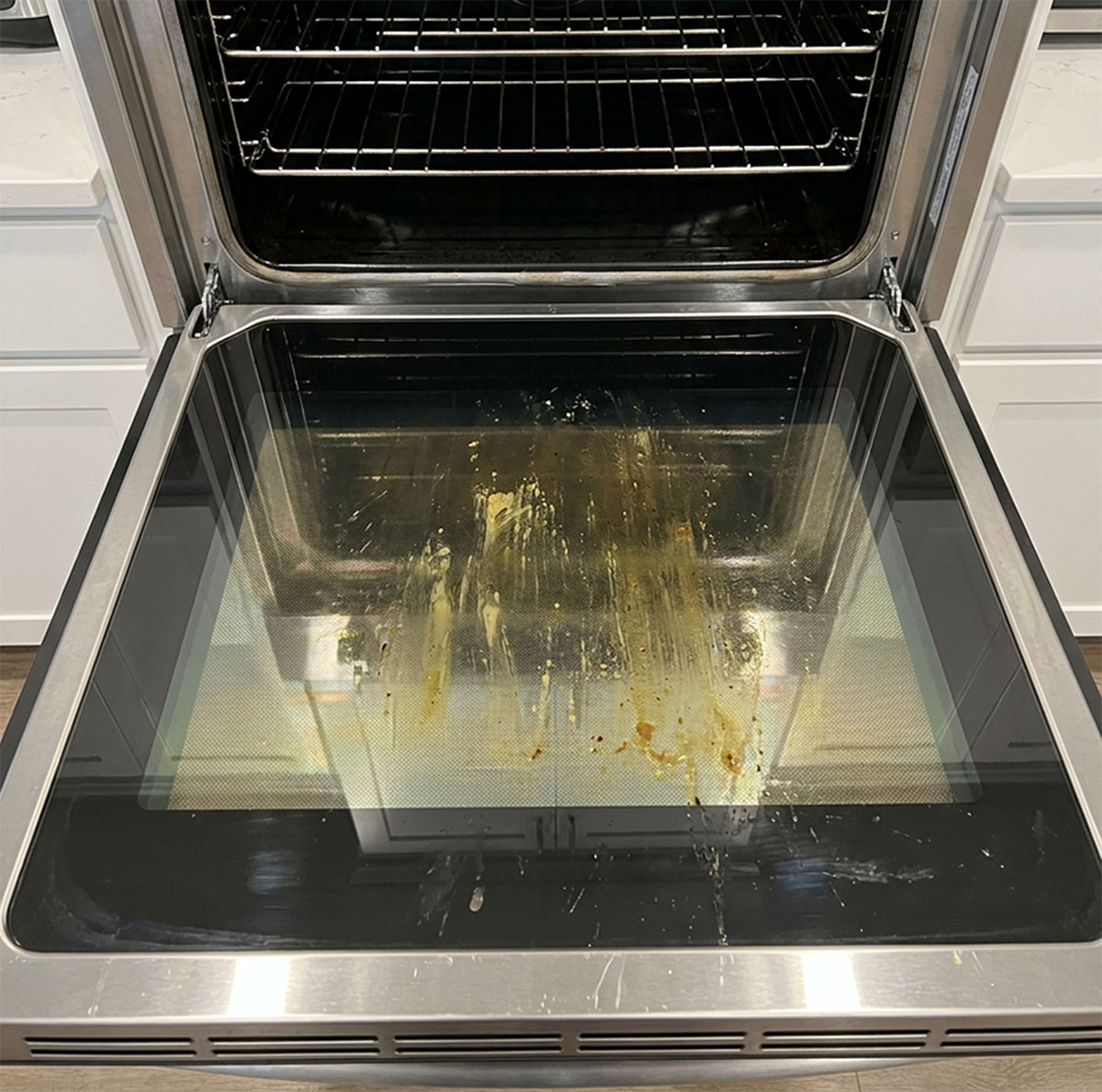
Grease Trapped Between Your Oven Door Glass? Don’t Book a Repair Yet
If you’ve ever looked at your oven door and wondered how grease got trapped between the two panes of glass, you’re not alone.
The outside is spotless. The inside of the oven sparkles. But sealed inside the door itself is a cloudy brown film you cannot reach — and it makes an otherwise clean kitchen look neglected every time you walk past it.
Most people assume there are only two ways out: live with it, or pay someone to fix it.
That assumption gets expensive fast. An appliance technician’s service call typically runs $150 to $350 before any parts, and many companies charge the diagnostic fee whether or not you approve the work. Homeowners who conclude the glass is permanently ruined start pricing a replacement door — commonly $200 to $400, and well past that on wall ovens and higher-end ranges, not counting installation. A surprising number of people skip straight to shopping for an entirely new range over what was never a mechanical fault to begin with.
Before you spend a dollar of that, three things are worth knowing: whether your oven is one of the many models you can clean yourself in about ten minutes, whether opening the door assembly would void your manufacturer’s warranty, and whether a home warranty or appliance protection plan you already pay for would cover the repair if you genuinely need one.
Why the Grease Gets in There in the First Place
Modern oven doors are built from two or three separate layers of glass with air gaps between them. That design keeps heat inside the cavity where it belongs and keeps the outer surface cool enough to touch safely.
The panels look sealed. They aren’t airtight.
Narrow vent openings around the edges — usually along the bottom lip, sometimes the top — let air circulate through the door. That’s deliberate; it’s part of how the cooling system works. But those same openings let grease vapor, steam, dust, and fine food particles drift inside a little at a time.
Every time your oven heats up, fat from whatever you’re cooking becomes airborne. Most of it vents away. A small fraction finds those gaps, settles onto the inner glass, and stays there, because nothing ever wipes it off. Ten years of roast chicken and bubbling casseroles later, you’ve got a permanent amber haze and no idea how it happened.
It isn’t a defect. It isn’t something you did wrong. It’s how nearly every oven door on the market behaves — GE, Whirlpool, Frigidaire, Samsung, LG, Bosch, KitchenAid, Maytag. The design is the reason.
The Mistake That Turns a 10-Minute Job Into a Repair Bill
The instinct is to grab a screwdriver and start taking the door apart.
Sometimes that works out. Plenty of models are built to come apart, and the manufacturer will tell you so. But others hide things you don’t want to meet by surprise.
Oven door hinges are under serious spring tension. On many ranges, those hinges store enough force to snap the door shut hard and fast if they’re released without the hinge locks engaged. People have broken fingers this way. It is not a theoretical risk, and it’s the reason manuals are emphatic about locking the hinges before the door comes off.
Beyond that, some doors use alignment clips that only seat one correct way, or bond the inner panel with high-temperature adhesive rather than screws. These come apart in twenty minutes and then refuse to go back together square. A door that no longer seals properly has stopped being a cosmetic problem: it leaks heat, your oven runs cold, your baking times go wrong, and now you truly do need the technician you were trying to avoid.
Then there’s coverage. Many manufacturers specify that disassembling the door assembly voids the warranty. If your range is still inside its original term — or covered by a home warranty plan or an extended appliance protection policy — a self-inflicted repair may not be eligible for a claim. Five minutes reading your paperwork can protect several hundred dollars of coverage you’ve already paid for.
So check the manual first. Nearly every manufacturer publishes model-specific cleaning guidance free online, and it takes almost no time to look up.
Because here’s what most people never discover:
On a large number of ovens, you don’t need to remove anything at all. The manufacturer built you a way in — it’s right there on the door, most people have never noticed it, and it takes one household item you already own.