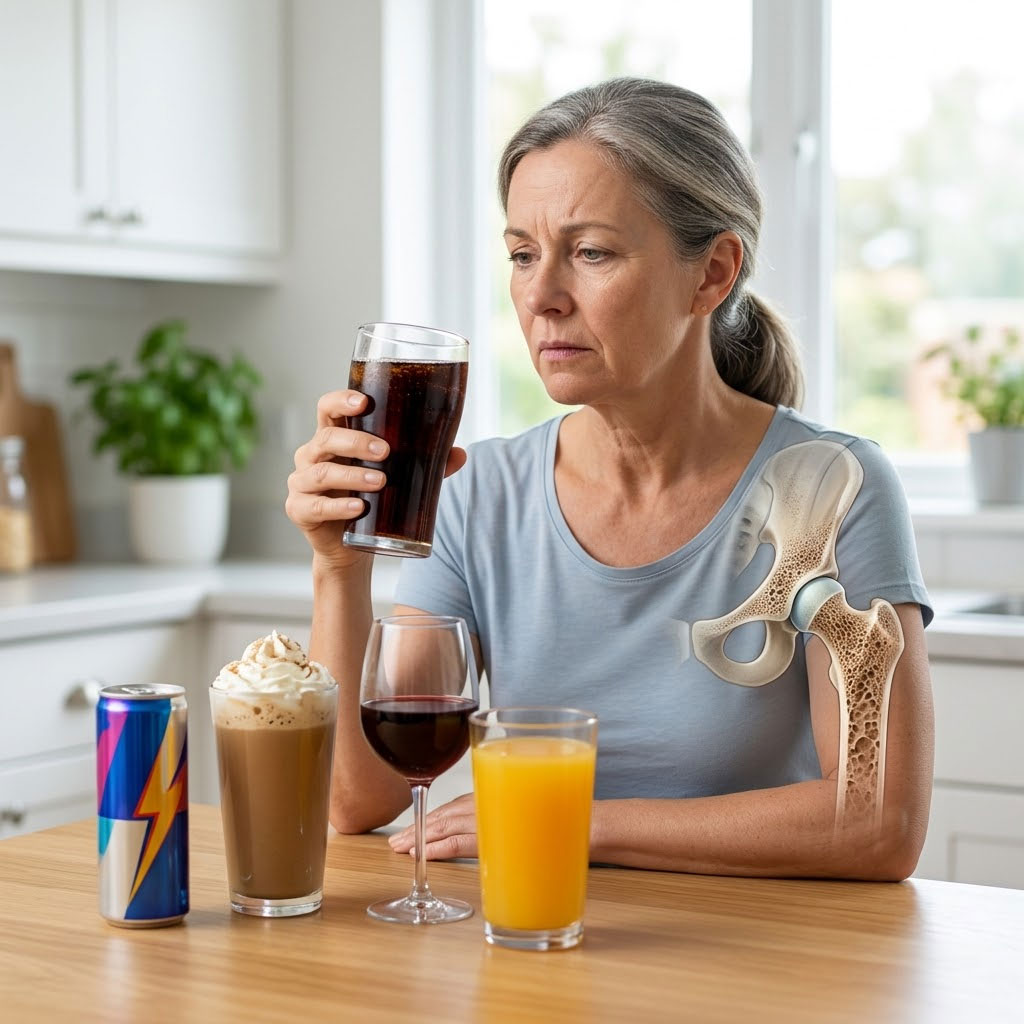
Someone steps off a curb wrong. Reaches for a bag on a high shelf. Slips on a wet floor — the kind of slip that would have meant a bruise at forty.
And a bone breaks.
That’s how most people find out. Not from a symptom, not from a warning, not from a twinge that built up over months. Osteoporosis is completely silent until the moment it isn’t. There is no ache that tells you your bone density is dropping. You can lose a third of it and feel absolutely fine, right up until the fracture that announces it.
Which is worth holding onto while you read the next few pages — because there’s a whole genre of advice about beverages and bone health, and it gets the proportions badly wrong.
Be Honest About the Drinks
Of the five beverages on the following pages, one has strong evidence behind it. The rest mostly share a single, indirect mechanism.
The cola story is the one everyone has heard — phosphoric acid leaching calcium from your skeleton. The research is considerably more equivocal than the headlines. The most-cited finding, from the Framingham osteoporosis data, linked cola specifically to lower bone density in women, but the likeliest explanation isn’t chemistry. It’s displacement. People drinking three colas a day are, overwhelmingly, people not drinking milk. The phosphoric acid in a can is a modest contributor next to the phosphorus in ordinary food.
Sweetened coffee drinks: caffeine does increase calcium loss in urine, by an amount so small that a few extra bites of yogurt cover it. Energy drinks: essentially no direct bone research exists — the article you’re about to read says as much. Sweet tea and fruit punch: displacement again, wearing a different label.
So four of the five are one idea in four costumes: these drinks are where the milk used to be. True, worth knowing, and nowhere close to the main event.
What Actually Decides This
For most women, the single biggest event in their skeletal life isn’t dietary at all. It’s menopause.
Estrogen restrains the cells that break bone down. When it drops, that brake comes off, and bone loss accelerates sharply — women can lose up to 20 percent of their bone density in the five to seven years following menopause. Twenty percent. In half a decade. No soda in history has done that.
The rest of the real list looks like this:
- A previous fragility fracture — any bone broken from a fall at standing height after 50. It’s the strongest single predictor that another one is coming.
- Long-term corticosteroids — prednisone and its relatives, taken for months rather than days.
- Medications people don’t connect to bone at all — long-term acid reflux drugs, some antidepressants, breast cancer aromatase inhibitors, certain diabetes medications.
- Smoking. Low body weight. A parent who broke a hip. Age itself.
Against that list, your beverage choices are a rounding error.
Why This Is Worth an Appointment
A broken wrist at 50 is an inconvenience. A broken hip at 78 is a different category of event entirely.
Across decades of studies, one-year mortality after a hip fracture runs somewhere between 15 and 30 percent. Not from the break — from what follows it: the surgery, the immobility, the pneumonia, the loss of the independence that was holding everything else together. Many who survive never walk the way they did before, and a substantial share never return to living on their own.
That is what osteoporosis actually costs, and it arrives without a single day’s notice.
Here’s the part that should be better known. The test is painless, takes about fifteen minutes, and Medicare covers it every 24 months for people who qualify. A DEXA scan — you lie on a table, a low-dose scanner passes over your hip and spine, and you get a number. Below −2.5 is osteoporosis. Between −1 and −2.5 is osteopenia, the stage where you still have room to change the trajectory.
The U.S. Preventive Services Task Force recommends screening for every woman 65 and older, and for younger postmenopausal women with risk factors. The Bone Health and Osteoporosis Foundation extends it to men over 70. Most people who qualify have simply never been offered it, and never thought to ask.
One of the five drinks ahead genuinely does belong on the list — it’s a documented, independent fracture risk factor, built into the calculator doctors use to estimate your odds. It isn’t the one that gets blamed.