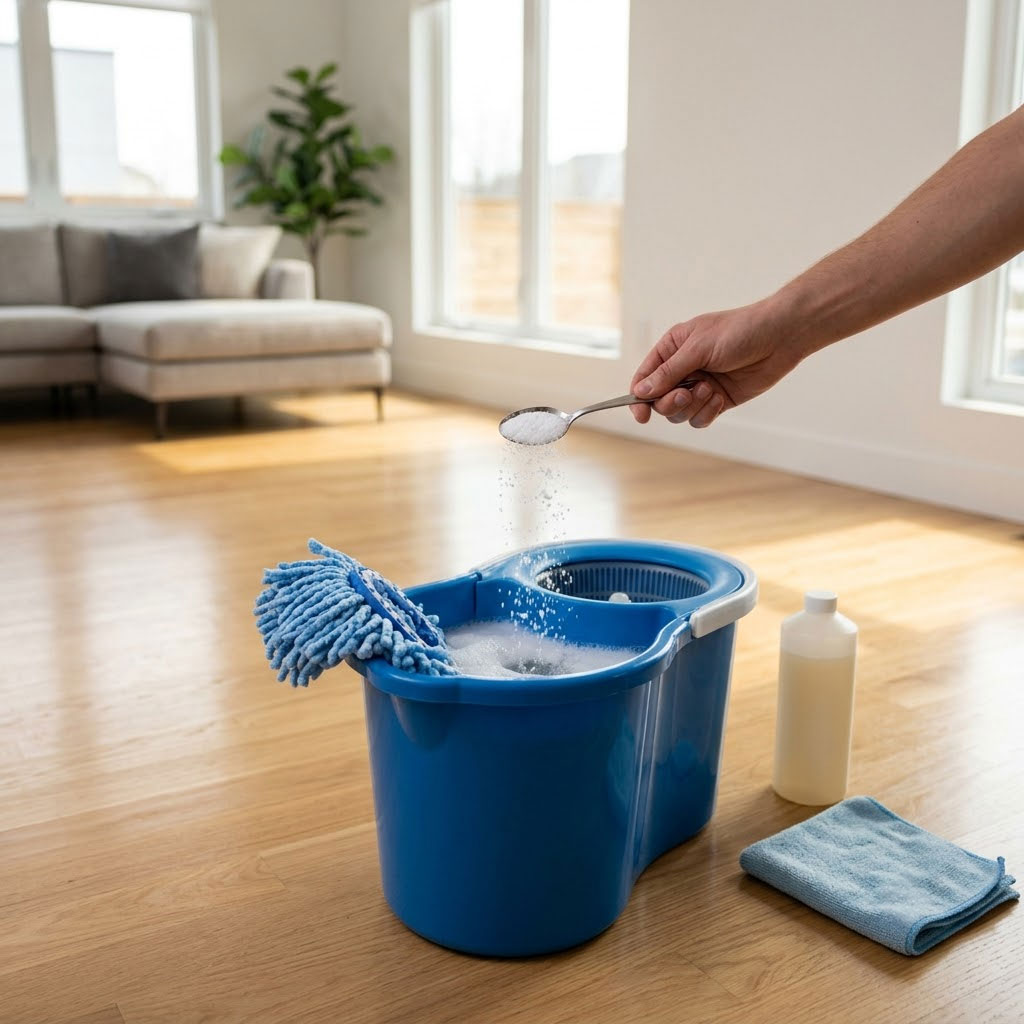
You mop. You do it properly. Four hours later there are dull patches, faint streaks, and footprints again, and the floor looks tired in a way that no amount of scrubbing seems to touch.
So you buy a stronger cleaner. Then a different one. Then you start adding things to the bucket because someone online swore by it.
Here’s what almost nobody tells you: a floor that looks dull after a proper mopping usually isn’t dirty. You’re solving the wrong problem, which is why nothing works. There are three separate things that make a clean floor look bad, and only one of them is fixable with a mop.
- Residue — a film sitting on top of the floor. Free to fix, today.
- Finish wear — the protective coating itself is scratched. No cleaner on earth touches this.
- Mineral film — your mop water is leaving deposits behind.
They look nearly identical. They have completely different price tags. And the bucket additives people swear by can make two of the three actively worse.
Test One: Is It Residue?
Take a small patch — a foot square, somewhere visible — and clean it with nothing but hot water and a microfiber cloth wrung out until it’s barely damp. No soap. Wipe it several times, changing to a clean section of cloth each pass. Let it dry.
If that patch comes up noticeably brighter than the floor around it, you’ve got residue, and every bottle of cleaner you’ve bought has been adding to it.
Two things cause it. The first is simple over-dosing — detergent past the dilution on the label doesn’t rinse away, it dries into a tacky film that grabs dust and footprints within hours. The second catches more people: shine-and-mop products. The old-school “restore your shine” liquids are acrylic polish. They don’t clean — they lay down a thin plastic layer. Each application adds another. After a couple of years that stack goes cloudy, yellows at the edges, and scuffs white under a shoe. It also has to be chemically stripped before a floor can ever be professionally recoated, which is why flooring pros wince when they see it.
Residue is the good news. It’s a weekend and a bucket of clean water.
Test Two: Is the Finish Gone?
Put a single drop of water on a dull spot and watch it.
If it beads and sits there, your finish is intact — your problem is on top of the floor, not in it. If it flattens out, darkens the surface, and soaks in within a couple of minutes, the protective coating in that spot has worn through. Nothing you mop with will bring that back.
This is what most “dull floor” complaints actually are, and the cause is grit. Sand and street dirt tracked in on shoes gets ground into the finish with every step. The scratches are individually invisible. Collectively they scatter light instead of reflecting it, and that’s what dullness is — a floor that’s optically rough. Perfectly clean. Still dull.
The fix is mechanical, and it’s a fork in the road worth understanding before you spend anything. If the wear layer is thinned but the wood underneath hasn’t been touched, a screen and recoat — abrading the old finish and laying a fresh coat over it — runs roughly $1 to $2 per square foot and takes a day. If you’ve gone through to bare wood, or there’s water staining, that becomes a full sand and refinish at around $3 to $8 per square foot. On laminate or luxury vinyl there’s no recoat option at all: the wear layer is factory-applied and once it’s gone, the only fix is replacement, commonly $3 to $7 per square foot installed.
The gap between those numbers is the whole reason to do the water test before you do anything else. Catching it at the recoat stage instead of the refinish stage is a difference of thousands of dollars on an average floor — and grit control, not cleaning product, is what keeps you on the cheap side of that line.
About That Washing Soda Trick
Worth being straight about this one, because it’s everywhere right now.
Washing soda is sodium carbonate, and it’s a genuinely strong degreaser — around pH 11, far more aggressive than baking soda. On ceramic and porcelain tile, grout, and sealed concrete, a spoonful in the bucket does real work on greasy build-up. Those surfaces don’t care.
On hardwood, laminate, or luxury vinyl, don’t. The National Wood Flooring Association, Bona, and essentially every flooring manufacturer specify pH-neutral cleaners for finished floors — and they warn against baking soda, which is only pH 8.3. Washing soda is hundreds of times more alkaline. High-pH solutions soften and cloud polyurethane over time. You’d be dulling the finish you’re trying to brighten, and on most floors you’d be voiding the warranty while you did it.
There’s a second problem nobody mentions: washing soda works as a water softener by binding calcium and dropping it out of solution as chalk. That’s the mechanism. If you’re on hard water, a bucket with washing soda in it is precipitating calcium carbonate onto your floor as it dries — a fine white haze that looks exactly like the dullness you started with.
So: water test first, then residue test, then pick your fix. If it beads and the patch test comes up bright, your floor is fine and your technique is the whole problem.
And technique is where the real gains are — twelve of them on the next page, including the one that does more to preserve a floor’s finish than every cleaning product combined, and it costs about thirty seconds a day.